How to introduce strengths to your client or participants
An adaptable session blueprint for getting started with strengths
What makes a strength?
A simple way to introduce strengths in coaching and facilitation is to start with one question:
What gives you energy?
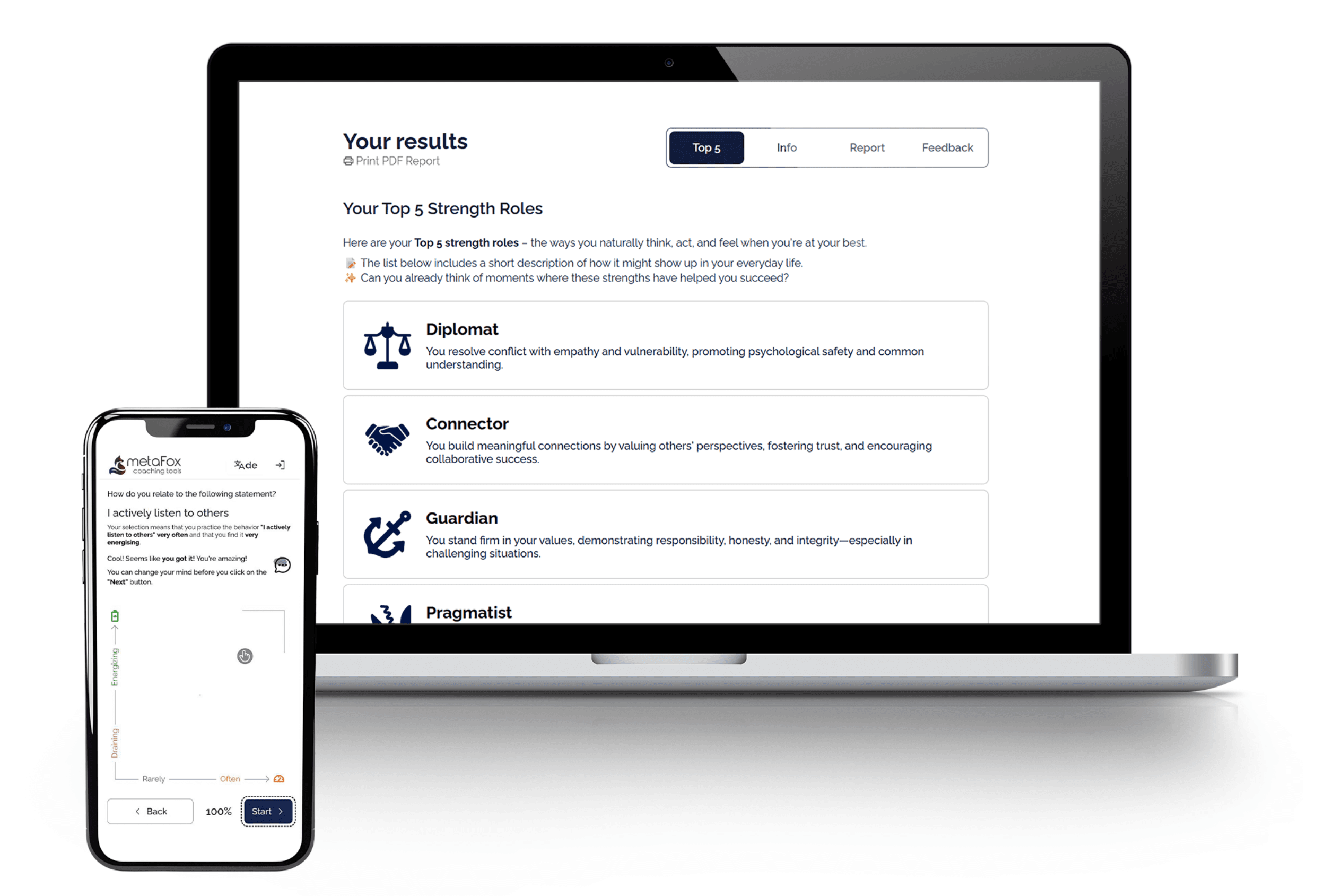
This page provides you with a workshop blueprint that you can adapt to your strengths practice. Use it before getting started with the Strengths Discovery Survey, or as an entry point to your report debrief.
The session blueprint can be used one-on-one or with a group and lasts 30 minutes or up to two hours, depending on how elaborate you dive into reflection and (peer-) coaching exercises.
The approach is grounded in positive psychology, a field shaped by researchers such as Martin Seligman, Ryan M. Niemiec, and Alex Linley. Their work shifted attention from deficits and dysfunctions toward positive traits, energy, and conditions that support sustainable performance and wellbeing.

When to use this format
This format works well when you want to:
- introduce the concept of strengths without starting with a questionnaire
- create a shared language for strengths in a team or group
- build curiosity and readiness for a strengths survey
- offer a low-threshold entry into strengths-based coaching
The underlying idea is simple: strengths are closely linked to energy, authenticity, and effectivenessnot just competence
Materials needed


Suggested session flow
The slides are structured in a way that supports a natural flow through four phases. Each phase can be shortened or extended depending on context and time.
Opening the session
Start by clarifying the purpose of the session:
Explore what strengths actually are
Notice patterns of energy and use
Create a shared language

Energy as an entry point
The core idea of this workshop is that energy is easier to observe than abstract traits.
Two Questions to ask:
- ↑ Which activities give you energy?
- ↓ Which activities drain your energy?
Facilitation Tip
Stay descriptive rather than interpretive. e.g. "Your voice became quicker" instead of "You were excited".
A practical definition
Instead of just listing competencies, we use a three-dimensional model to identify true strengths.
Energy
Does this activity fuel or drain you?
Use
How often do you get to use this capacity?
Performance
Do you reliably create value or results with it?
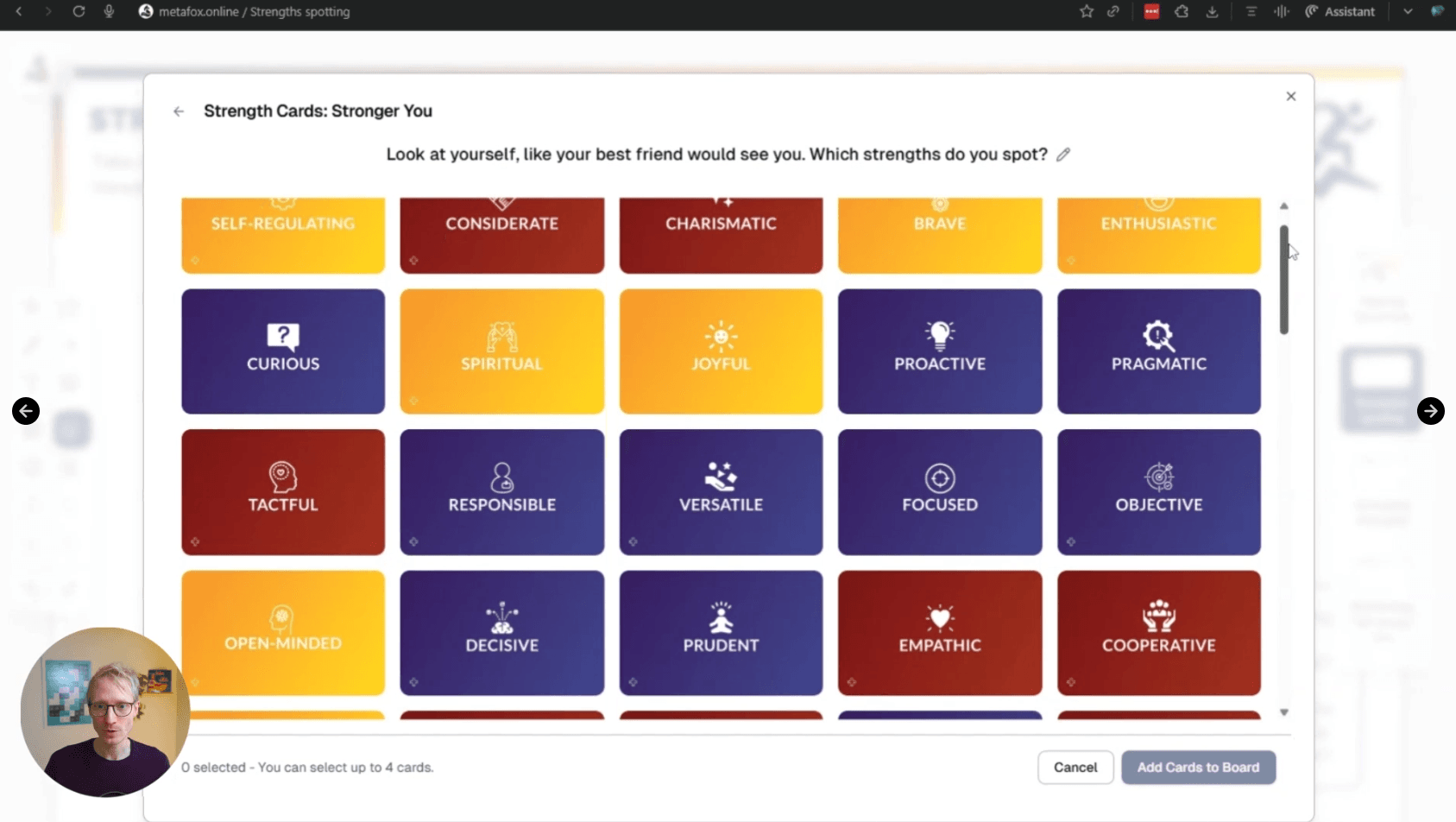
Selecting strengths words
Invite participants to choose up to three strengths words using the metaFox Strength Coaching Cards.
Probing Questions
- Pick strengths that feel energizing.
- When did you use this recently?
- What happened as a result?


Peer coaching
Once strengths are selected, participants work in pairs using the Stronger You cards or digital prompts.
Simple Structure (3-5 min per person)
- Person A shares a recent moment where one strength showed up.
- Person B reflects what they heard, focusing on energy, actions, and outcomes.
- Switch roles
Sorting strengths into four categories
Participants sort their selected strengths into four categories using two axes: energy and use.
This results in two strengths being distributed into the four categories (note: depending on how you briefed the strengths selection beforehand, you will likely only have "Unrealized" and "Realized" strengths as you asked for "What gives you energy". You can explain this or even skip the Weakness and Learned Behavior parts entirely, depending on how deep you can go, given available time).
Unrealized Strengths
Used rarely, but Energizing
How can you give this strength more room?
Realised Strengths
High Performance - Used often - Energizing
Where can you deploy this strength?
Are there areas where you actually 'overuse' it?
Weaknesses
Low Performance and Draining
Who - or which strength - can support you in this area?
Learned Behavior
Used often, but Draining
Which strength can you use instead in this area?

7. Ways to continue
Go deeper in coaching
Choose one quadrant from the matrix above and explore it in depth. This is an excellent anchor for follow-up sessions!
Use the Strengths Discovery App
The app adds structure, a ranked profile, and a full report to the insights gained in this session.
Go to Strengths AppThe workshop explained in 10 minutes
On this video, metaFox Co-Founder Tobi leads you through the workshop flow described above.
Closing thought
Starting with energy shifts strengths work from labeling to lived experience.
It invites clients to notice what already works, what costs them, and where small changes can make a meaningful difference. This workshop format creates that awareness and sets the stage for more focused, data-informed strengths work.
Frequently asked questions
Coaching that starts from what already works for a client and builds on it. It is grounded in positive psychology, a field shaped by researchers such as Martin Seligman, Ryan M. Niemiec and Alex Linley. In practice you find the strengths a client already uses and the ones they could use more, then turn that into one small next step.
Start with energy: "Which activities give you energy?" and "Which activities drain your energy?" Once a client has picked a few strength words, ask "When did you use this recently?" and "What happened as a result?" When you reflect back, stay descriptive: say "your voice became quicker" rather than "you were excited".
Energy givers are activities that fuel you, energy drainers are the ones that wear you out. They are the entry point of this session plan because energy is easier to observe than abstract traits. They also lead straight into the model: a strength gives you energy, while a learned behavior drains it even when you do it well.
In this session plan, participants choose up to three strength words from the metaFox Strength Coaching Cards, picking the ones that feel energizing. Then they work in pairs with the Stronger You cards: one person shares a recent moment where a strength showed up, the other reflects back what they heard, and they switch. Each turn takes three to five minutes.
The session plan takes between 30 minutes and two hours, depending on how much time you give to reflection and peer coaching. It works one-on-one or with a group, and every phase can be shortened or extended to fit the time you have.
Still have questions?
We're here to help you get the most out of the Strengths Discovery.
Email to app@metaFox.eu
Author: Tobias Weghorn
Co-Founder metaFox
Tobi Weghorn is the co-founder of metaFox and product manager behind the Strengths Discovery App. In his own journey as a client, strengths had a tremendous impact on him, so that he dug deep into theory and practice and made strengths an essential tool in his own coaching and facilitation practice.
in Connect with Tobi on LinkedIn